
Companies that stumble during peak-season shipments rarely fail on the ocean leg — they fail on backward planning. "Booking in September feels too early, only to find in November that space is gone, rates have surged, and goods are still stuck at the factory." This article gives no schedules and no quotations — only the things that decide peak-season success: the backward-planning method, countdown timelines for three selling seasons, rate mechanics, two calendars, and split-shipment strategy.


The Only Correct Method: Plan Backward from the Sell Date

The first rule of peak season: **the starting point is not the vessel's departure — it's the day the goods must be sellable.**
The backward chain is fixed, and every link needs a buffer:
Sell date ← warehouse availability ← customs clearance & pickup ← destination port operations ← ocean main leg ← loading & export declaration ← CFS consolidation ← factory handover
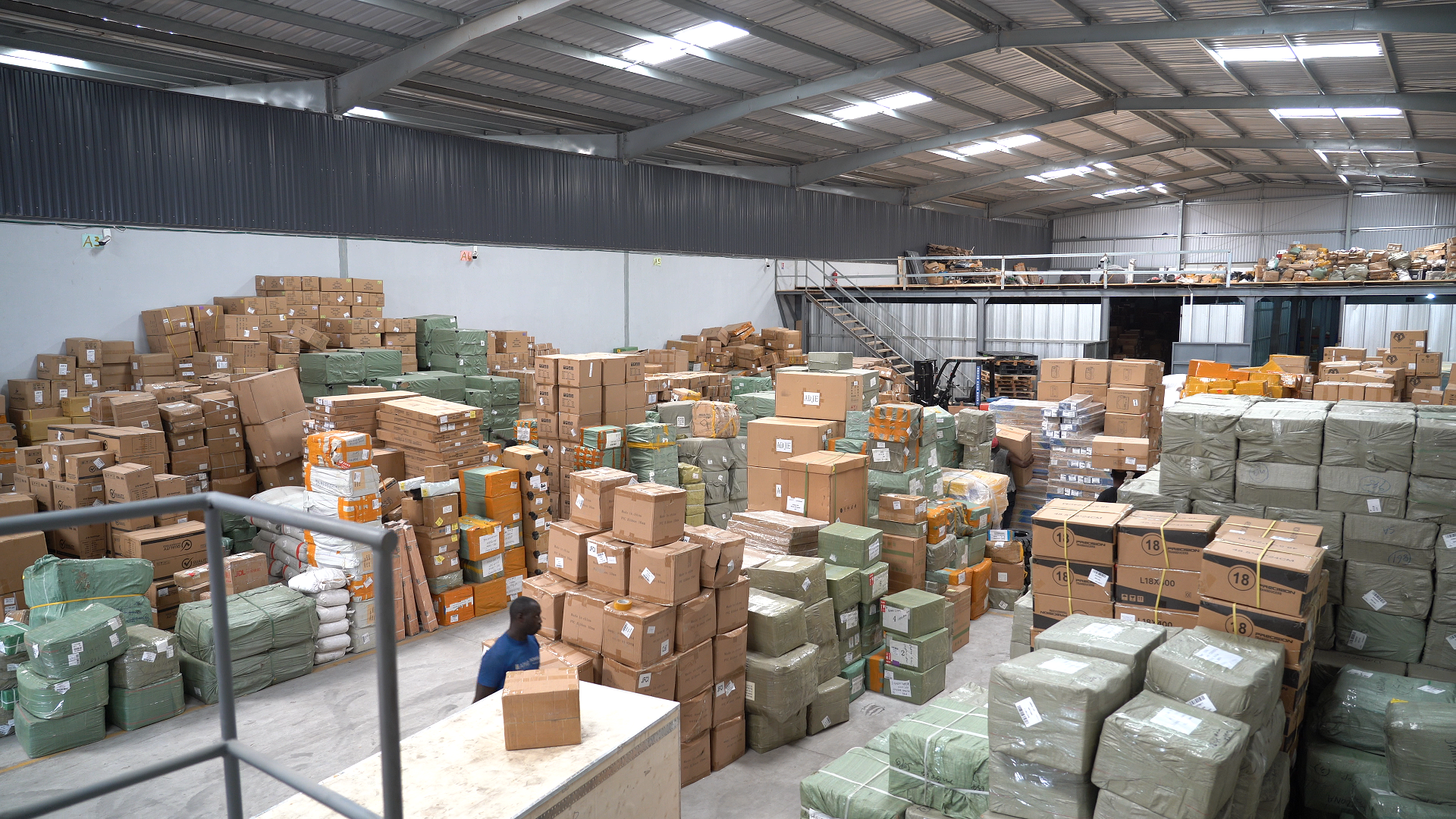
Planners who get this wrong schedule only the ocean leg and treat congestion, customs inspection and inland delivery as free. In peak season those are exactly the links that stretch: Lagos yards before Christmas, Gulf ports before Ramadan. **A buffer is insurance you buy, not time you waste.
Typical transit windows (confirm against your actual port pair): Gulf direct services roughly 2–3 weeks; East Africa 3–4 weeks; West Africa mostly transshipped, 4–6 weeks — add 1–2 weeks of transshipment buffer on top of any direct-service figure.
Countdown Timelines: Black Friday, Christmas, Ramadan
The three dates in this title carry very different levels of urgency. On the real 2026–2027 calendar they form three situations: one already too late to plan calmly, one closing fast, and one where starting now is exactly right — with a scheduling collision few articles ever mention.
Black Friday & Cyber Monday (27 / 30 Nov 2026)
Backward: to be sellable by mid-November, West African transshipped cargo should have sailed in September, Gulf direct cargo by mid-October. From today, the ocean main leg is effectively out of reach. The realistic play has two moves: air-freight the gap for proven, high-margin SKUs only; and don't treat Black Friday as the only date — January is a cheaper ocean window for warehouse replenishment after the holiday, so slot late cargo into January for post-Christmas sales and next-cycle stocking.
Christmas (25 Dec 2026)
Backward: on-shelf by mid-December → allow 1–2 weeks for clearance and pickup → container must arrive by early December → sail by mid-November for Lagos, late November for East Africa, early December for the Gulf. That makes this very week the final booking window for Christmas ocean cargo. The extra warning is at destination: Lagos congestion builds 3–4 weeks before Christmas and persists into January; inspection rates climb too. Give Christmas cargo a wider destination buffer than usual — not a narrower one.
Ramadan (starting 8 Feb 2027; Eid al-Fitr around 9–10 Mar)
This is the only major node where starting now is exactly right — and the one most often misread. A common mistake: Ramadan demand is not one wave but two — pre-Ramadan household stocking (food, daily goods, home items, sellable late January into early February) and pre-Eid restocking (apparel, gifts, appliances arriving by late February for March sales).
The 2027-specific risk: Chinese New Year and Ramadan are two days apart. CNY 2027 falls on 6 February; Ramadan starts 8 February — the factory-shutdown window and the Gulf/North-Africa port slowdown window almost fully overlap. Cargo sailing after mid-January catches neither: too late for pre-Ramadan production, too early for the post-CNY restart. The correct rhythm: finish production by mid-December, ship by late December–early January, and treat CNY as a hard backstop. For the Eid wave, note that its production window (January) straddles the pre-CNY rush and the post-CNY restart — ship only what is certain before CNY, slot the rest after, and don't gamble.
One rule changes every year: Ramadan drifts about 11 days earlier in the Gregorian calendar — in 2028 it is expected to begin around late January, turning the "Ramadan meets CNY" collision from a risk into the norm. Redo the timetable against the new moon calendar every year; never copy this year's dates forward.
How Peak Rates Actually Form

Don't watch index points — watch the mechanism. Peak rates are driven by four forces:
Concentrated demand: replenishment and seasonal cargo stack up, and capacity tightens;
Withdrawn capacity: blank sailings control utilization — the name says "canceled," the function is "priced up";
Surcharges stacking: Peak Season Surcharges (PSS) and GRIs arrive in waves — the number on the rate sheet and the number on the invoice may not match;
Short quote validity: peak-season quotations expire faster than usual.
One takeaway: confirm validity periods and surcharge details on every peak-season quote, or the "low price" is just an invoice that hasn't landed yet. Compare like with like: same cargo, same scope, same validity window.
Capacity on Africa & Middle East Lanes Is a Different Game

On transpacific and Europe lanes, peak season is fought on price — dense direct services and transparent indices. On our lanes, it's fought on certainty:
- Few direct calls, more transshipment: many West and East Africa services transit a hub, and hub congestion concentrates delays exactly when it hurts;
-Rolling cargo is normal: for time-sensitive cargo, ask at booking "if this sailing rolls, when is the next one" — and write the answer into your delivery promise;
- Destination capacity is the ceiling: the bottleneck is often not the sea — Lagos yards, Mombasa clearance speed, inland trucking;
- Air freight gets crowded too: seasonal high-value cargo competes for lift; book early.
Two Calendars: Demand-Side Festivals × Supply-Side Holidays

The classic peak-season mistake is reading one calendar. You must align two:
Demand side — what your buyers are stocking for
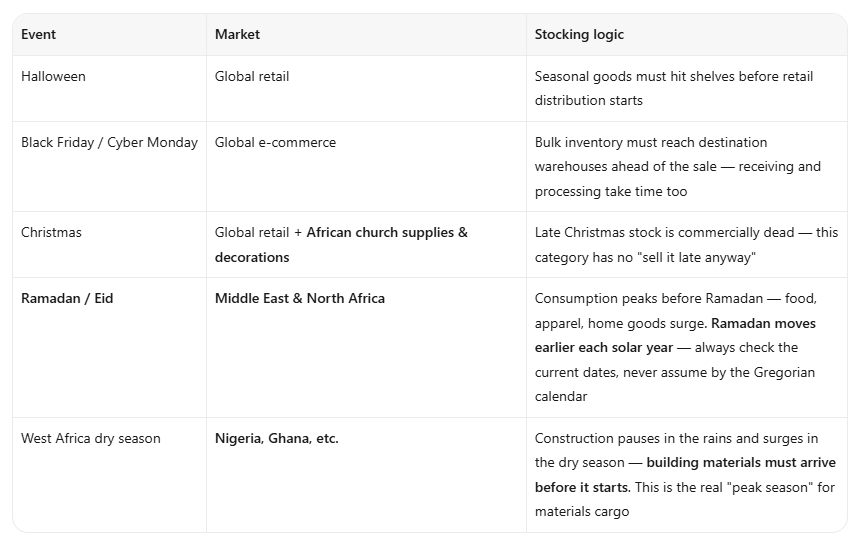
Supply side — Chinese holidays that cut the chain
Golden Week (early October)and Chinese New Year (January–February, per the official calendar each year)** are the two gates. CNY hits harder: longer factory closures, slower workforce return, sharper post-holiday rate rebounds.
Two rules:
1. Production isn't the only thing that must finish before the holiday — pickup, CFS, customs declaration and vessel loading all have cutoffs; miss one link and you wait for the whole chain to restart;
2. **Book before the holiday, re-verify after** — carriers adjust schedules and rates around both holidays; the first task after reopening is confirming your space and quotes still stand.
Split Shipment: Ocean for Volume, Air for the Gap

The most effective peak-season risk control is not choosing one mode — it's not betting everything on one channel:
- Planned volume by ocean: cost-efficient, booked backward from the sell date;
- The gap by air: a fast lane reserved for the styles that sell out and the production that runs late — top up the shortfall only;
- A backup plan for critical cargo: for core seasonal inventory, confirm alternative sailings or routings in advance — not after the rolling notice arrives.
The prerequisite is communicating forecast volumes early: you can discuss space before production finishes, locking bookings with agreed cargo-ready deadlines so the reservation stays executable.
Six Things to Confirm Before Booking
1. Space and equipment confirmed (verbal availability ≠ a booking)
2. Whether the sailing risks cancellation or schedule change
3. Cargo cutoff and documentation cutoff times
4. Quote validity and the surcharge detail — included and excluded
5. If rolled: next sailing schedule and cost responsibility
6. Quote scope: destination charges, customs clearance, delivery included or not
A low first leg is not a low total cost— never more so than in peak season.
What CHOICE Shipping can do on this lane

CHOICE International Freight has specialized in Africa and Middle East lanes for 29 years:
- Early planning and locking of peak-season space, with rolling contingencies;
- Pre- and post-holiday consolidation, customs and CFS scheduling;
- Destination coordination at Lagos, Mombasa, Jebel Ali and beyond;
- Ocean-plus-air split shipment design.
Schedules and rates are confirmed case by case. Peak-season uncertainty cannot be eliminated — but it can be planned for. That is the entire point of this guide.
CHOICE,Delivery So Easy

CHOICE Supply Chain Technology Co, Ltd . was establishedin 1997 and has 29 years of experience in Africa&Middle-east logistics. We have already established more than 10 wholly-owned branches in Africa&Midle East, namely Kenya, Rwanda, DRC, Cameroon, Nigeria, Ghana, Côte d'Ivoire, Saudi Arabia, UAE. CHOICE can provide Groupage Service,Full Container Service,Overseas Warehouse Service for our customers. If you have freight transportation needs, welcome to contact us. Tel: 400-613-8847.


Choice Groupage service
Daily/Weekly schedule
Cargo security guarantees
Professional warehousing in China and Africa
With powerful specialized custom clearance team
With 29 years’ experience in sea freight consolidation service
Contact us:400-613-8847

CHOICE International Freight, focusing on cross-border logistics in Africa & the Middle East. Founded in 1997, with 29 years of logistics experience, it provides one-stop cross-border logistics services such as air transportation, sea transportation, and overseas warehousing.
Tel: 400-613-8844