
Saudi Arabia, this once veiled and mysterious country, is now opening its doors wide and witnessing a retail "explosion".

Saudi Arabia's retail sector has seen a comprehensive strengthening, with the growth rate in the online segment leading the way by a significant margin.
In the context of a global consumer market experiencing a slowdown in growth, intensified competition within the e-commerce sectors in Europe, America and Southeast Asia, and continuous profit compression, the core market of the Middle East - Saudi Arabia - is leveraging its booming retail economy to become a crucial strategic stronghold for Chinese cross-border sellers to avoid the fierce competition in the mainstream market and explore high-margin growth opportunities.
According to the latest industry data from the authoritative Middle East business media Arabian Business, in the first quarter of 2026, the overall retail transaction volume in Saudi Arabia reached 113 billion US dollars, showing a steady year-on-year growth of 6.8%.
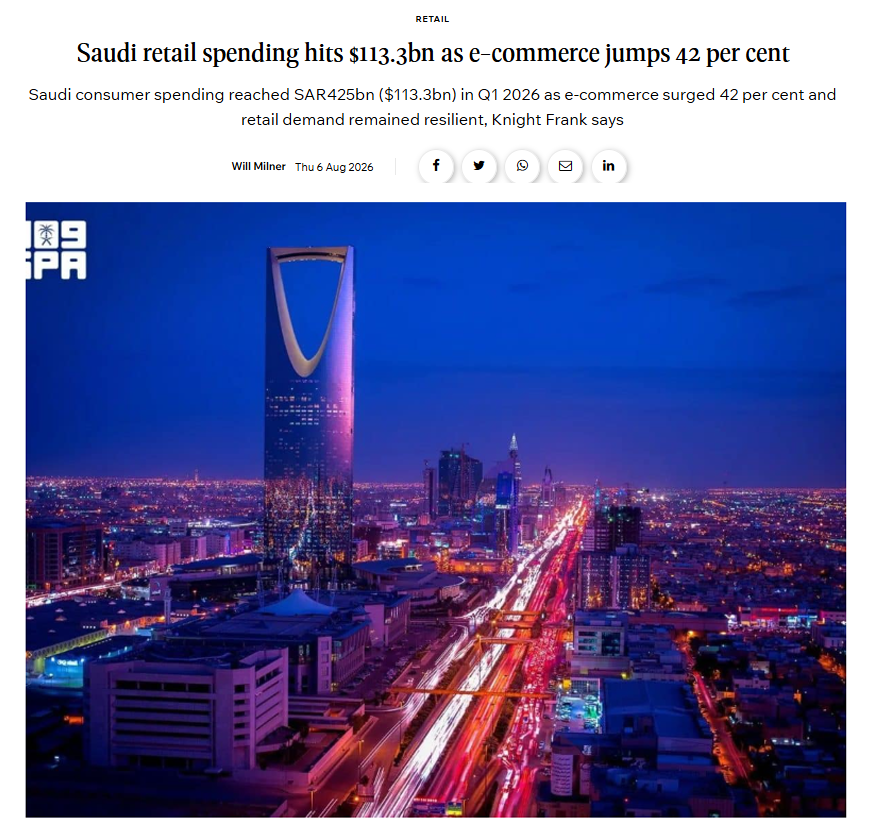
Unlike the steady growth of offline physical stores, Saudi Arabia's online e-commerce retail sales soared by 42% year-on-year. The trend of digital consumption transformation has been completely solidified, becoming the core engine driving the growth of national consumption.
Based on industry forecasts, the Saudi consumer market will maintain a positive growth rate of over 4% throughout 2026. In an environment where most economies around the world are experiencing consumption contraction, it will achieve an independent growth trend. Additionally, the potential for festival consumption in Saudi Arabia is extremely strong. Key events such as Ramadan and Eid al-Fitr can single-handedly drive retail sales of over 17.3 billion US dollars in a single month, and the explosive power of major promotions far exceeds that of regular markets.

The four fundamental principles that underpin the market's explosive growth
By deeply understanding the underlying logic of the market, the Saudi Arabia boom is not a short-term traffic bonus, but rather a long-term benefit resulting from the combination of four factors: policies, population, consumption habits, and economic structure. It has sustainable overseas expansion value.
1. Economic transformation shifts from virtual to real, and residents' consumption power continues to be unleashed
Relying on Saudi Arabia's "Vision 2030" national strategy, the country has been continuously moving away from its sole reliance on the oil industry. The proportion of GDP from non-oil industries has been increasing year by year, and residents' disposable income has steadily grown. Data shows that over 33% of Saudi citizens plan to increase their consumption expenditure in 2026, and both consumption confidence and consumption willingness have risen, providing a stable market
2. Younger population structure strengthens the basic foundation of e-commerce consumption
Saudi Arabia has a highly advantageous population structure. The median age of its population is only 28 years old, and 65% of the population is under 40 years old. The young group constitutes the core consumer force. The local internet penetration rate and the popularity of mobile devices are nearly saturated. Users spend over 7 hours per day online, and they have an extremely high acceptance of new consumption models such as social media promotion, short video e-commerce, and live-streaming e-commerce, providing excellent soil for cross-border refined operations and content-based monetization.
3. Digital consumption habits have been fully adopted
Currently, nearly 80% of retail transactions in Saudi Arabia are completed through electronic payment. The proportion of online shopping via mobile devices has exceeded 50%, and the penetration rate of social e-commerce continues to rise. 61% of consumers discover and place orders for products through social platforms. Traditional offline consumption scenarios are continuously migrating to the online domain, creating conditions for cross-border sellers to break geographical restrictions and expand their product distribution across the entire region.
4. The market competition landscape is relatively relaxed, with a significant blue ocean attribute.
Compared to the situation in Europe, the United States, and Southeast Asia where Chinese sellers are concentrated and there is intense price competition, the proportion of Chinese sellers in the Saudi Arabian e-commerce market is relatively low. Local consumers do not blindly compare prices; they place greater emphasis on product quality, design texture, and compliance. They are willing to pay a premium for high-value-added products, making this a scarce high-margin and low-competition sector in the cross-border industry.

Saudi Arabia's Best Product List
Based on the actual purchase data of e-commerce consumers in Saudi Arabia, the following product categories have the most demanding demand:
👗 Fashion clothing (with an 87.7% online shopping rate): This is undoubtedly the top category. Besides international fast fashion, modern Muslim fashion (combining conservative and trendy designs) is rapidly gaining popularity.
Opportunities for Chinese sellers: Affordable trendy clothing, sportswear and casual wear, modern women's clothing with strong design elements, and accessories.
💄Beauty and Personal Care (46.2% online shopping rate): Driven by climate and culture, skincare, makeup, sunscreen, and perfumes (especially high-end fragrances) are necessities.
Opportunities for Chinese sellers: Skincare products developed based on local climate conditions, portable beauty devices, products with halal certification, and products with unique fragrances.
📱Consumer electronics (with a 36.9% online shopping rate): Saudi Arabia is one of the regions with the highest smartphone penetration rate globally, and there is a strong demand for smart wearables, digital accessories, and small smart home appliances.
🏠Home and Fast Consumer Goods: Driven by large family sizes (averaging nearly 5 people) and the "stay-at-home economy", there is a strong demand for home decoration, kitchen supplies, and storage solutions. Fresh food and groceries in the Quick Commerce sector account for 53.6% of the revenue, and pet care is the fastest-growing sub-segment (with a CAGR of 23.78%).

Seller's Practical Tips for Entering the Market
For new sellers entering the market, we will share detailed suggestions for on-site operation to help avoid common mistakes made by beginners.
Compliance aspect: It is essential to ensure the completeness of VAT tax registration and compliance reporting, adapt to the local 15% VAT policy, and eliminate the risks of platform penalties and store traffic restrictions.
Operational level: Focus on local adaptation, optimize Arabic language scripts, create main image videos that align with Arab aesthetics, and target the core female consumer group's needs.
Procurement level: Plan the core peak seasons such as Ramadan, Eid al-Fitr, and Black Friday 1-2 months in advance to secure inventory and seize the peak traffic periods.
In terms of execution: Newcomers can conduct small-scale trial orders by air to quickly obtain market feedback. Based on the test data, they can replenish stocks promptly or clear out the inventory.
The Saudi circuit, with its long-term policy advantages, a high-quality consumer base, and scarce market supply, has become the most optimal growth opportunity for Chinese cross-border sellers to break free from internal competition and reshape their profit structure. By leveraging the mature domestic supply chain advantages and making early strategic positioning, it is possible to seize the billion-dollar retail growth window in the Middle East.

If you have air freight requirements for the UAE, Saudi Arabia or Africa, please add the customer service WeChat (choice199725).

【Disclaimer】
The resources in this article are sourced from the Internet. If there are any corrections or if there is any infringement, please leave a message in the WeChat official account's backend. We will handle it effectively after verification.
CHOICE International Freight, focusing on cross-border logistics in Africa & the Middle East. Founded in 1997, with 29 years of logistics experience, it provides one-stop cross-border logistics services such as air transportation, sea transportation, and overseas warehousing.
Tel: 400-613-8844