The Middle East electronic components market offers unprecedented opportunities. Companies can capitalize on this critical window by aligning with local demand and regional policy directions.
Amidst the thriving global electronics industry, the Middle East market—particularly the UAE and Saudi Arabia—is experiencing a triple dividend period driven by energy transition, digital transformation, and consumption upgrades. This paints a long-term, sustainable growth blueprint for the electronic components sector.
Public data shows that in 2024, China-Middle East bilateral trade reached USD 487.2 billion. Electrical and electronic goods were among China's top exports to the region.
Specifically, according to China Customs statistics, China's integrated circuit (IC) exports hit a record high of USD 159.5 billion in 2024, surpassing mobile phones (USD 134.36 billion) to become the single largest export commodity by value. This represented a 17.4% year-on-year increase.
1
The potential of the Middle East electronic components market
Key Market Transformation Dividends:
Saudi Arabia's "Vision 2030": Explicitly identifies industry (including electronics and communication equipment manufacturing) as an economic pillar. Megaprojects like NEOM include advanced manufacturing bases. Saudi Arabia aims to increase the industrial sector's contribution to GDP from 13% in 2020 to 25% by 2030.
UAE Industry 4.0:Targets increasing the industrial sector's GDP contribution from AED 133 billion (~USD 36.2 billion) in 2023 to AED 300 billion (~USD 81.7 billion) by 2031 (UAE Cabinet Resolution), focusing on advanced technology industries like electronics, communication equipment, and semiconductors.
Nascent Local Manufacturing & Production Demand
The UAE (especially Dubai, Abu Dhabi) and Saudi Arabia are actively attracting foreign investment, leveraging their location, logistics, and policy advantages (e.g., free zones, preferential tax rates) to position themselves as hubs for electronics manufacturing and re-export to the Middle East, Africa, and Europe.
Saudi Arabia has established a National Semiconductor Center, planning to attract 50 chip design firms supported by a SAR 1 billion (~CNY 1.936 billion) fund, targeting 1 million wafer design capacity by 2030.
Localization mandates for finished goods production and industrial automation adoption across the region are driving demand for industrial-grade electronic components.
New Energy Transformation Unlocks Niche Potential
Saudi Arabia and the UAE are aggressively pushing energy transitions, heavily investing in renewables like solar and wind. This accelerates demand for energy storage, driving rapid growth for key equipment like inverters.
China's inverter exports to Saudi Arabia and the UAE surged by 694.9% and 68.6% year-on-year respectively in Jan-Feb 2025, indicating massive growth potential in this segment.
Smart City & Automotive Market Boom
Mega smart city projects (e.g., Saudi NEOM, Dubai's Dubai Creek Harbour) rank among the world's largest investments (Mordor Intelligence). Cities like Dubai, Riyadh, and Doha are deploying vast IoT sensor networks, smart meters, surveillance systems, and data centers, fueling demand for components (sensors, connectors, MCUs, PMICs, etc.).
The Middle East automotive market is undergoing dual electrification and smart transformation. Core EV components, automotive electronics, ADAS systems, and charging infrastructure require temperature controls, radar, vision sensors, smart meters, and more.

Strategies for Exporting Electronic Components to the Middle East Market
Target Key Segments: Focus based on product strengths
Consumer Electronics Components: Target mobile phone, home appliance assembly plants and brands.
Communication & Networking Components: Serve 5G infrastructure and data center projects (leverage Chinese equipment vendors like Huawei, ZTE as key channels).
Industrial & Automotive Electronics: Meet manufacturing automation and EV adoption demands (strongly promoted in KSA/UAE).
New Energy Electronics: Support solar PV and energy storage projects (strong presence of Chinese PV companies locally).
Smart City Components: Focus on sensors, security/surveillance chips, smart meter modules.
Leverage Policy Incentives & Localization
Closely monitor localization policies (e.g., Saudi-China Special Economic Zone offering tax exemptions/subsidies).
For key markets and large clients, consider establishing local teams for rapid response, technical support, and after-sales service to build trust.
Partner with established Chinese players (Huawei, ZTE in comms; Haier, Midea in appliances; EPC contractors in infrastructure) to embed into their supply chains.
Ensure Compliance & Certification
Strictly adhere to export controls (especially dual-use items) and sanctions regulations. Utilize export credit insurance to mitigate payment risks. Monitor regional political dynamics.
Obtain mandatory regional certifications:
UAE: ECAS (Emirates Conformity Assessment Scheme).
Saudi Arabia: SASO (Saudi Standards, Metrology and Quality Organization), especially SALEEC (for low-voltage appliances/equipment) and IECEE CB Scheme certification conversion.
GCC: GCC Conformity Marking (G Mark - gaining traction). Proactively understand the latest target market regulations to avoid customs clearance issues.
Focus on brand building and trust building
Participate in key regional trade shows (e.g., GITEX GLOBAL Dubai, Middle East Energy Dubai).
Implement localized marketing (Arabic content, culturally sensitive communication), emphasizing quality, reliability, and long-term partnership commitment.

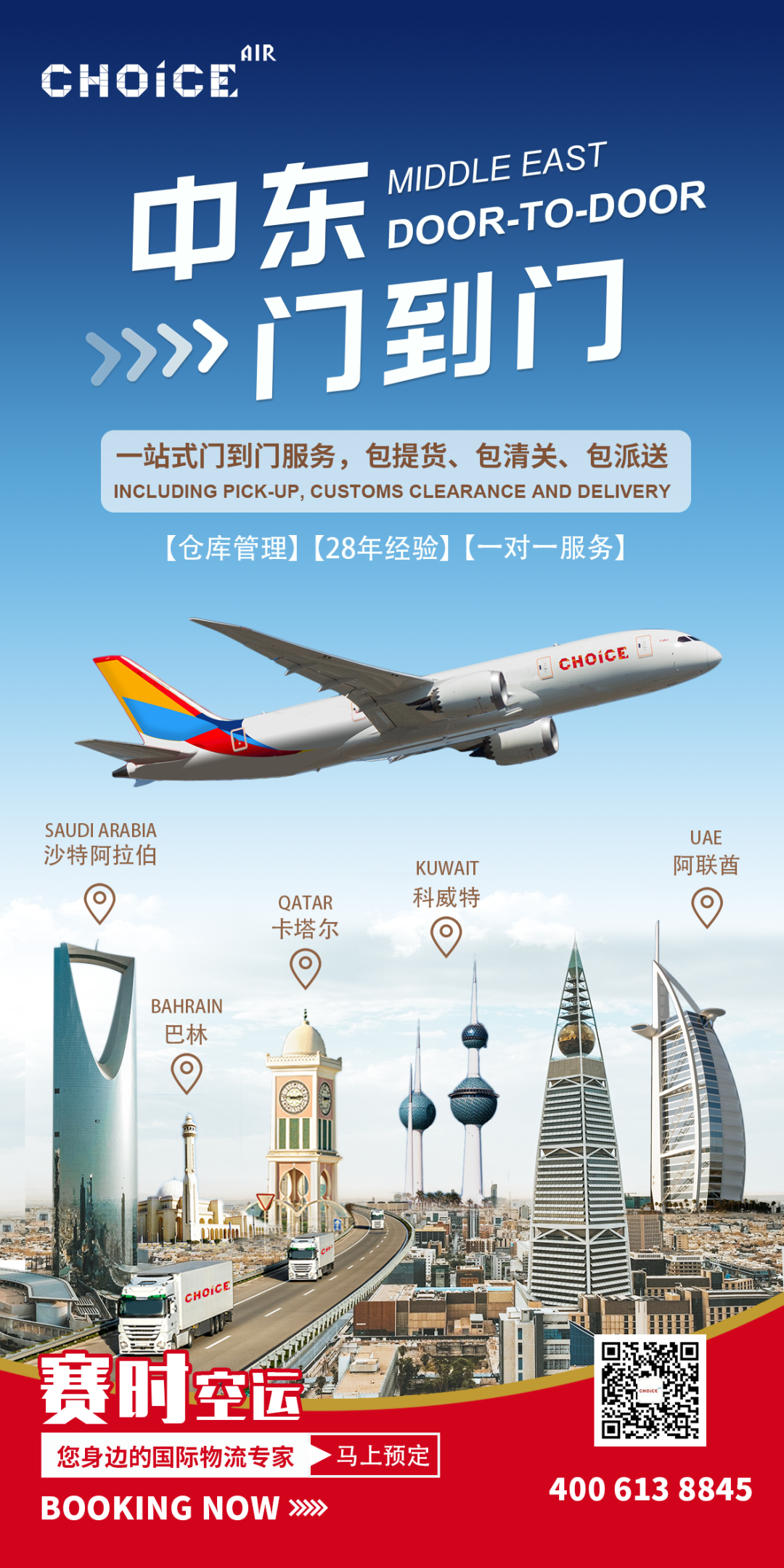
The Middle East electronic components market offers unprecedented opportunities. Companies can capitalize on this critical window by aligning with local demand and regional policy directions.CHOICEAIR, as an international logistics company rooted in the Middle East and African markets, provides one-stop door-to-door solutions in the Middle East, helping you expand your export market in the Middle East and enhance your product competitiveness.

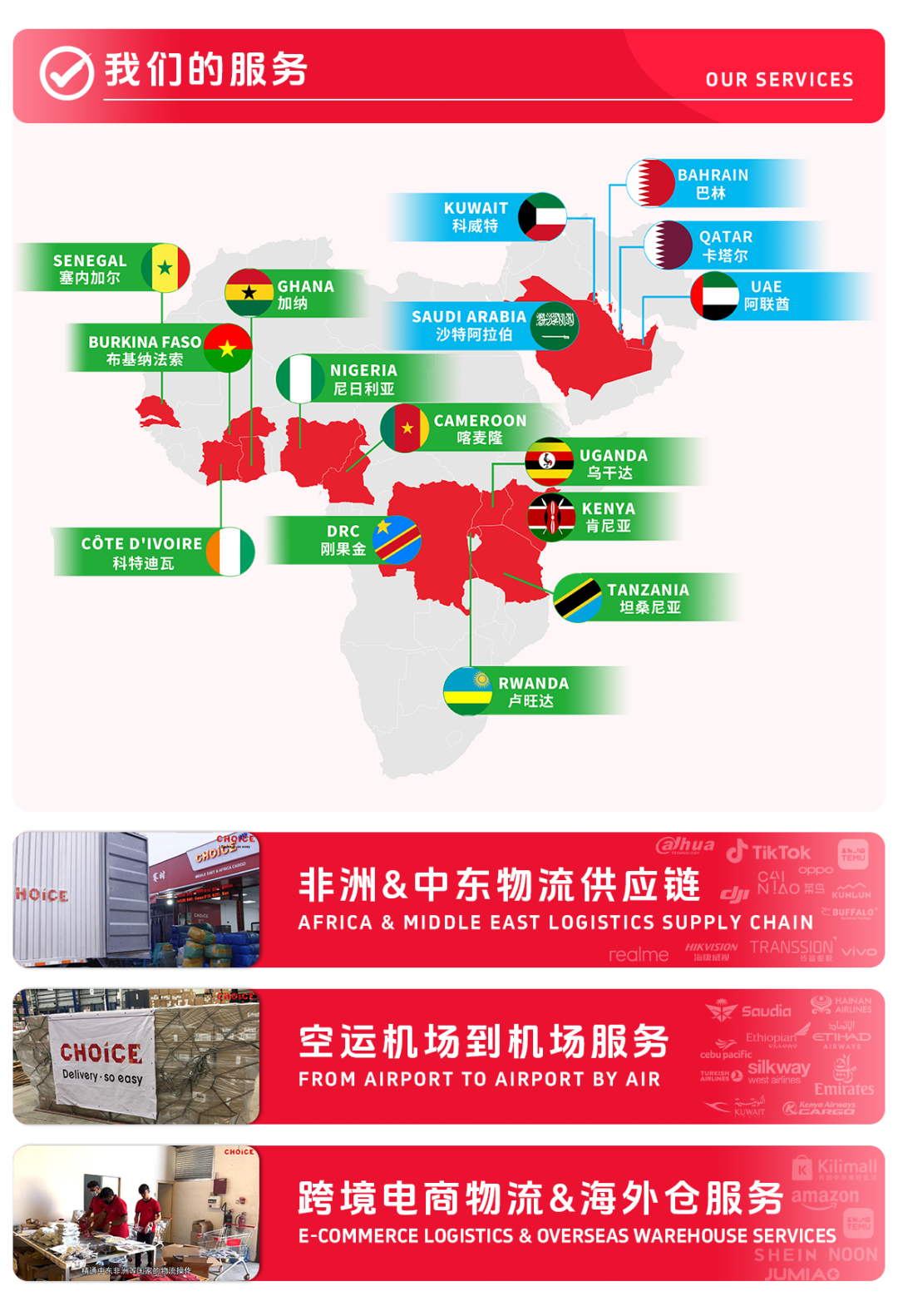



CHOICE International Freight, focusing on cross-border logistics in Africa & the Middle East. Founded in 1997, with 29 years of logistics experience, it provides one-stop cross-border logistics services such as air transportation, sea transportation, and overseas warehousing.
Tel: 400-613-8844