Africa is home to a city unlike those ancient capitals steeped in millennia of history.
Its distinction lies not only in its relatively short history but also in the fact that it has never stopped developing since its inception.
This is Nigeria's capital—Abuja.
1
Established by Relocation: The Origin of the "New City"
To break free from the situation of the former capital, Lagos, being "overcrowded and located in the far southwest," the government decided to build a new capital in the central geographical location of the country.
In 1976, the Nigerian government announced the move of the capital from Lagos to Abuja.
In stark contrast to the crowding and bustle of Lagos, Abuja presented a completely different picture.
The city is situated in the center of Nigeria's territory, offering convenient transportation, a pleasant climate, low population density, and land available for future expansion.
In 1991, the Nigerian government officially moved to Abuja, located within the administrative region known as the Federal Capital Territory (FCT).
Since then, Abuja became Nigeria's first purpose-built and planned capital city, making "planning" and "construction" its defining characteristics.
2
Meticulous Planning: The Construction and Development of the "New City"
After more than thirty years of development, Abuja's urban layout demonstrates a fusion of science and art.
The city center houses national government institutions and commercial districts, featuring high-rise buildings like the Presidential Villa, the National Assembly Complex, and legislative and judicial departments, forming a clear political core.
Today, Abuja is home to over 50 districts containing important national institutions, landmarks, and architecture.
Additionally, sites like the National Botanical Garden, the National Christian Centre, the National Mosque, and Abuja's largest park, Millennium Park, reflect its diverse development.
The iconic Zuma Rock stands prominently to the north of the city.South of the city center are the main residential areas, while the southern end is zoned for industrial use.
Although Abuja's commercial development may not rival that of Lagos, its convenience for daily life is not inferior, and luxury goods from around the world are readily available.
According to world population statistics, Abuja's population has reached 4 million, making it the fourth most populous city in Nigeria.
Major ethnic groups within the city include the Afo, Gbagyi (Gwari), Hausa, Goro, and Bassa, among others, leading to a collision and fusion of different cultures.
English is the city's official language, but other native languages like Hausa, Yoruba, and Igbo are also spoken.
Regarding religious beliefs, approximately half of Abuja's residents are Muslim, 40% are Christian, and the remainder practice other faiths such as traditional religions, with people of different beliefs coexisting harmoniously here.
3
Pulsing with Vitality: The "New City's" Industry and Trade
As a meticulously planned and developing city, the real estate sector is undoubtedly a major driver of Abuja's economy.
Benefiting from the housing and commercial demands generated by rapid urban growth, the real estate industry has not only created numerous job opportunities but also spurred the development of related industrial chains.
Furthermore, Abuja is a key area for Nigeria's agricultural transformation, aiming to establish itself as a hub for modern agriculture by attracting investment and introducing agricultural technology and machinery.
Abuja serves as Nigeria's "gateway" for international trade and diplomacy.It is often the preferred location for hosting national-level international economic and trade fairs, such as the "Abuja International Trade Fair" and the "Africa Agri & Food Expo."
Abuja is also a distribution and circulation center for goods within Nigeria.
Located at the heart of the country, Abuja boasts the most developed north-south highway network and an international airport (Nnamdi Azikiwe International Airport).
It acts as a "transit hub" for agricultural products from the north moving south to consumer markets and export ports, as well as a "distribution center" for consumer goods from the south moving north.
Culture sportive
Abuja is often seen as a microcosm of Nigeria itself, showcasing the diversity of the country’s over 250 ethnic groups.
The city’s inhabitants reflect a cultural melting pot, where languages, arts, cuisines, and traditions from across Nigeria converge.
This diversity enriches Abuja’s cultural scene, making it a vibrant location for experiencing the nation’s heritage through festivals, art exhibitions, and gastronomy.
This city, which moved from blueprint to reality, is shaping a new model of urban development for Nigeria and even Africa through its continuous construction, relentless innovative vitality, and inclusive, open-minded spirit.
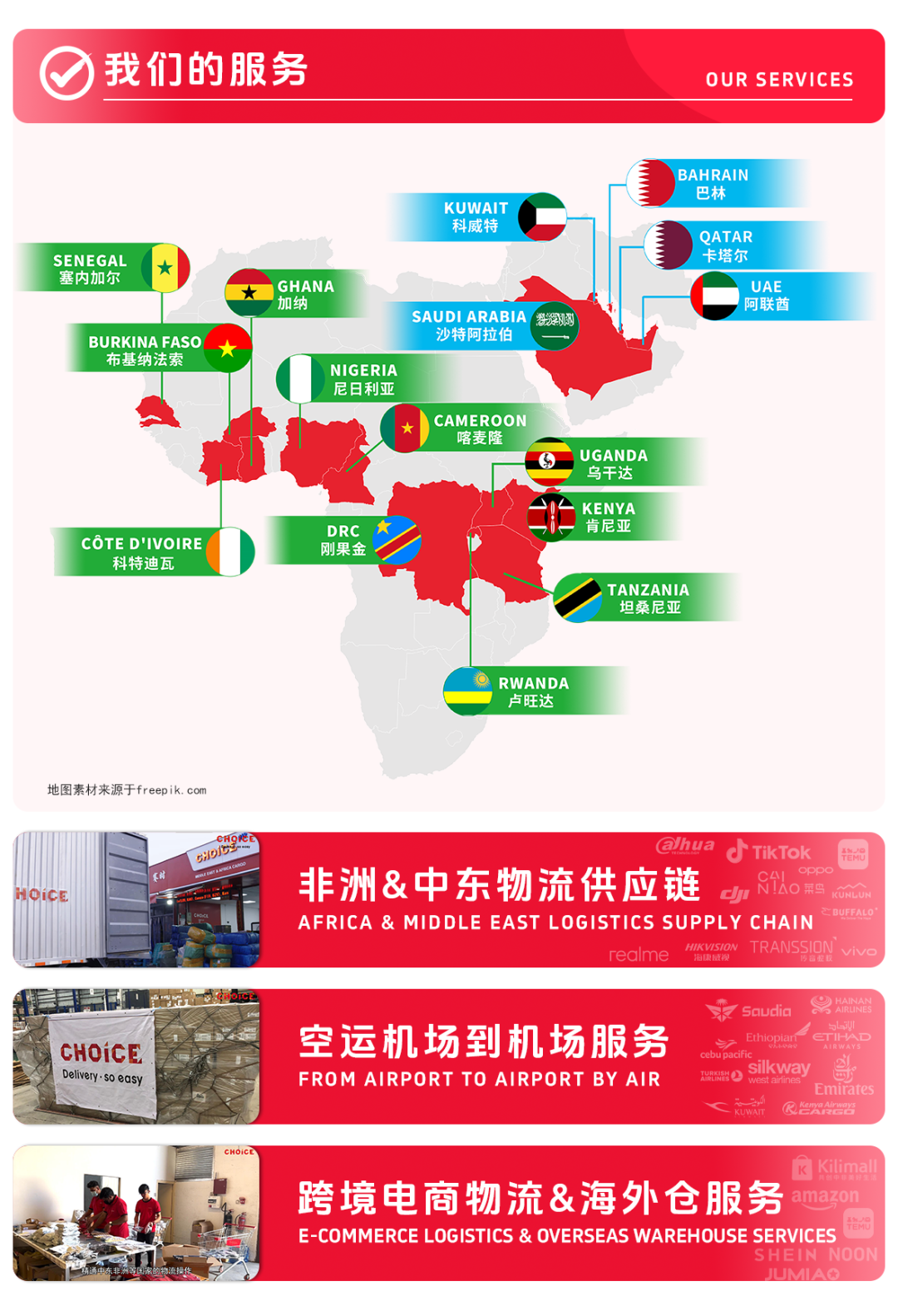
CHOICEAIR offers warehouse-to-warehouse logistics services from China to Abuja, with strategically located outlets close to key markets. We are committed to providing safe, fast, and professional freight services for commercial and trading enterprises, ensuring your cargo arrives safely and securely in Africa.
CHOICE was founded in 1997, opened wholly-owned branches and warehouses in African countries, built 10+ logistics lines, has formed a safe and efficient end-to-end logistics supply chain solutions in the African market, the strength of China's exports to Africa for you to solve the logistics problems.




ChoiceAir respects and advocates the protection of intellectual property rights. The images or parts of the content quoted in this article are for reference and information dissemination purposes only, if there are any errata or suspected infringements, please inform us in the comments and we will deal with them effectively after verification.
https://www.villaafrika.com/fct-abuja-city-profile/
https://www.britannica.com/place/Abuja-national-capital-Nigeria
https://en.wikipedia.org/wiki/Abuja#Economy_and_infrastructure
https://heydipyourtoesin.com/understanding-nigeria-abuja/
https://populationstat.com/nigeria/abuja
https://etichotels.com/journal/10-surprising-facts-about-abuja/
https://english.news.cn/africa/20230923/bf658c2f798d4983a6ebd99999950c79/c.html
https://ads.investgo.cn/country/country-news/detail/399174
CHOICE International Freight, focusing on cross-border logistics in Africa & the Middle East. Founded in 1997, with 29 years of logistics experience, it provides one-stop cross-border logistics services such as air transportation, sea transportation, and overseas warehousing.
Tel: 400-613-8844