This ancient city, carrying a millennium-old trade route, is the "lifeline" supporting the economic circulation of the East African mainland.
It is Kenya's second-largest city – Mombasa.
1
City Canvas: A Tropical Harbor and Ancient City
Mombasa is a coastal city in southeastern Kenya, bordering the Indian Ocean.
Due to its strategic location, the city was first settled by Arab traders, with its port formally established by Arabs in the 11th century, primarily for the trade of spices, gold, and ivory.
Over the centuries, merchant ships from Persia, India, and Europe followed. By the 12th century, it was already a thriving trade hub.
In the early 15th century, the great Chinese explorer Zheng He of the Ming Dynasty led his massive fleet on seven voyages, reaching Mombasa.
Subsequently, Mombasa was contested and colonized by the Portuguese, Omani Arabs, and the British, with these diverse cultures profoundly influencing the city's architecture, religion, and customs.
After Kenya's independence in 1963, Mombasa became Kenya's second-largest city, continuing to develop based on its natural harbor advantages.
Today, blending multicultural influences, a long history, and natural scenery, Mombasa thrives on tourism and international trade, showcasing the vibrant energy of a port city.
2
Economic Lifeline: Hub and Spoke Influence
Leveraging its exceptional geographical position, Mombasa is not only a distribution center for Kenya's imports and exports but also the "gateway to the sea" for landlocked countries like Uganda, Rwanda, Burundi, and eastern Democratic Republic of Congo, making it the economic "lifeline" of East Africa.
Moi International Airport is Kenya's second-largest airport, with daily flights to Nairobi and other destinations within Kenya, Europe, and the Middle East.
The airport also handles significant air cargo through its freight terminal.
Meanwhile, the Port of Mombasa is the largest seaport on the East African coast, leading the region in terms of berths, cargo throughput, and mechanization levels.
With the recovery of tourism and the growth of cross-border e-commerce, the airport plans to expand its cargo facilities to match the port's logistics efficiency, forming a coordinated "sea-air linkage" transport system.
Furthermore, connections to the China-constructed Standard Gauge Railway (SGR) and surrounding national road networks facilitate domestic transport in Kenya and create a logistics network covering the East African hinterland.
This further solidifies its regional hub status.
Industrial Spillover
Driven by the port's advantages, industries such as oil refining, ship repair, mechanical repair, textiles, cement, metal processing, and food processing have developed in Mombasa.
The vehicle assembly industry stands out with an annual growth rate of 25.8%, and the tax-free incentives offered by the Mombasa Special Economic Zone for up to 10 years are attracting more light manufacturing companies to set up operations.
3
Population Profile: A Growth Blue Ocean Driven by a Young Population
Mombasa is undergoing rapid urbanization, with a population of approximately 1.5 million. In 2024, Mombasa's population growth rate was 3.9% per year.
The city has a diverse resident structure, primarily comprising the Swahili and Mijikenda peoples. The main religions in the city are Christianity and Islam.
According to a 2024 population structure sample survey by the Kenya National Bureau of Statistics and Mombasa city labor employment reports, over 70% of Mombasa's population is under 30 years old, with the labor force accounting for 46%, forming a vast consumer and producer group.
Consumption Level
In 2024, Kenya's GDP per capita was $1,949.9. As an economic center, Mombasa's consumption level is significantly higher than the national average (World Bank 2024 Kenya Economic Outlook data).
The middle class already accounts for 23% of the city's population, and their consumption focus is shifting from basic necessities to home appliances, automobiles, education, and other areas.
The Mombasa home appliance market is growing at an annual rate of 10%, with demand for durable goods like air conditioners and refrigerators continuously rising due to accelerating urbanization (2025 East Africa Digital Trade Outlook).
Siphoning Effect
As a regional trade gateway, Mombasa consistently attracts a large transient population, constituting about 18% of the total city population (based on 2024 Kenya Immigration Service city residence permit statistics and Mombasa Chamber of Commerce cross-border trader surveys).
This includes, for example, Ugandan and Tanzanian traders dealing in small commodities, and Chinese employees working on construction projects, all contributing to Mombasa's consumer market and residential development.
One of Sub-Saharan Africa's Oldest Cities
Old Town Mombasa was first populated in the 10th century.
In texts from the 12th to the 14th centuries that have been discovered, Arab scholars also mentioned the city.
Whatever the exact date of its founding, Mombasa is undoubtedly one of the oldest cities in sub-Saharan Africa.
The exotic Old Mombasa Town features Arab and Portuguese architecture,busting bazaars, quaint antique stores, and the scent of spices.
Its old-world charm is on top of everyone's bucket list.
The Largest Jain Population in Africa
Despite the fact that most of Mombasa's residents are Muslims, the city has one of the largest Jain populations in Africa.
The religion has been practiced in the country for over 100 years and there is also a Jain Temple in Mombasa.
Fort Jesus has been won and lost nine times
The fort was made a UNESCO World Heritage site in 2011 and serves as a museum today.
Fort Jesus was a critical player in nine different battles between nations that wanted control of the Kenyan coast, including Portugal, England and Oman.
From a 9th-century Arab trading post to a 21st-century East African hub, Mombasa has never ceased moving forward.
For global investors seeking opportunity, Mombasa is not just a gateway for goods but also the key to understanding the African market.
CHOICEAIR offers warehouse-to-warehouse logistics services from China to Kenya, with strategically located outlets close to key markets. We are committed to providing safe, fast, and professional freight services for commercial and trading enterprises, ensuring your cargo arrives safely and securely in Africa.
CHOICE was founded in 1997, opened wholly-owned branches and warehouses in African countries, built 10+ logistics lines, has formed a safe and efficient end-to-end logistics supply chain solutions in the African market, the strength of China's exports to Africa for you to solve the logistics problems.

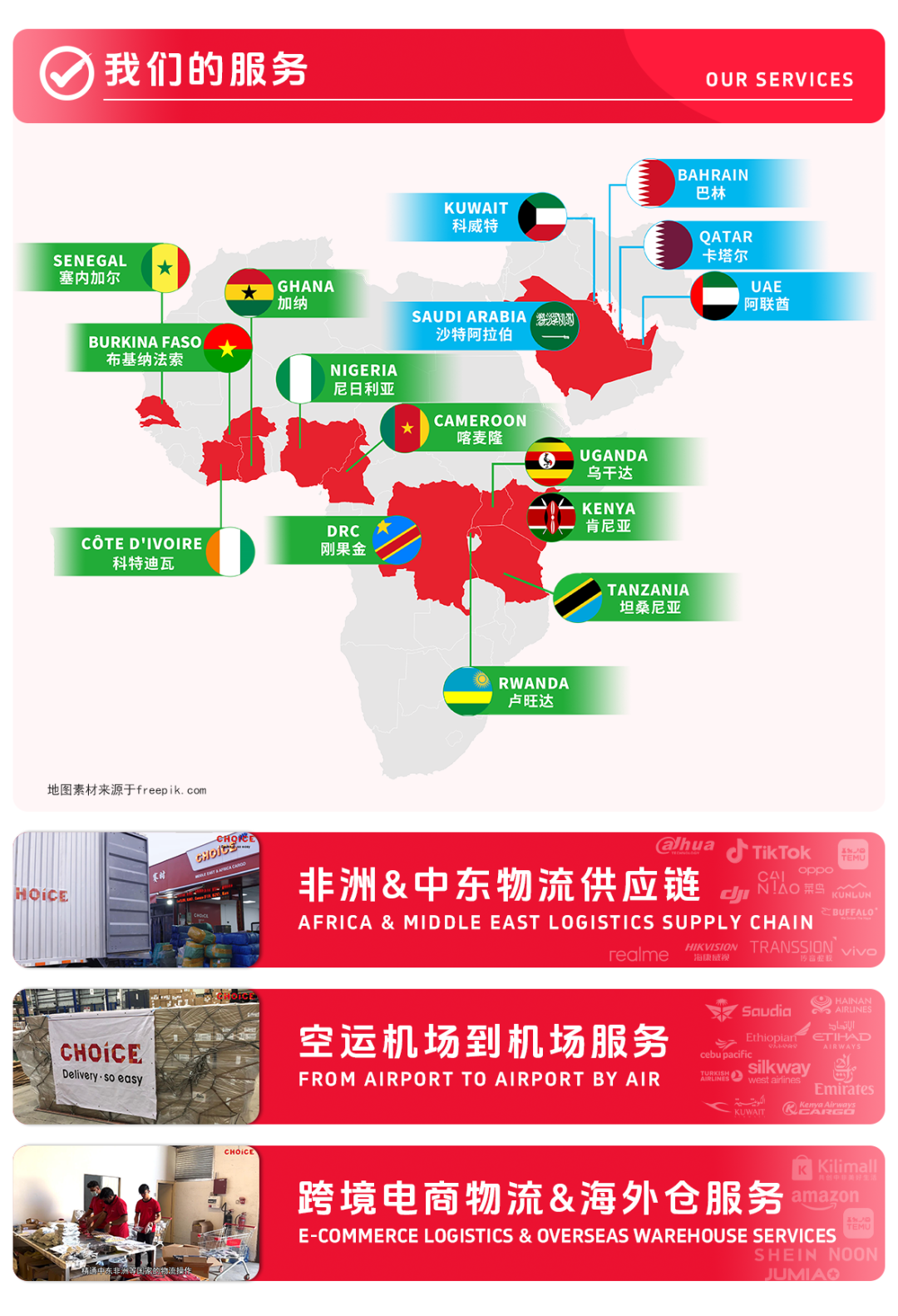



CHOICE International Freight, focusing on cross-border logistics in Africa & the Middle East. Founded in 1997, with 29 years of logistics experience, it provides one-stop cross-border logistics services such as air transportation, sea transportation, and overseas warehousing.
Tel: 400-613-8844