Preface
Africa’s GDP growth of 4.5 per cent outperformed the global average, with intra-African trade exceeding US$213.8 billion.
This year, China-Africa trade has sent a strong signal.
According to customs data, China’s trade with African countries reached RMB 1.14 trillion in the first five months of the year. This was the first time that trade passed the RMB 1 trillion mark during the same period, up 18.2% year on year.
At the same time, the 2026 Africa Trade Report shows that Africa’s average GDP growth reached 4.5% in 2025, up from 3.4% in 2024 and above the global average for the same period.
One signal is faster economic growth. The other is record-high China-Africa trade. Put together, they show that Africa is being seen in a new way.
In the past, many people first associated Africa with minerals, agricultural products, weak infrastructure, fragmented markets, and complex business conditions. But Africa is changing. More countries are building industries, developing manufacturing, advancing energy projects, improving the business environment, and strengthening trade links across the region.
For Chinese companies, Africa’s role is also changing.
It is no longer just a market for consumer goods or resource trade. It is becoming a new growth area for equipment, supply chain cooperation, energy solutions, and two-way trade.
01
Why Is Africa Growing Faster While Global Growth Slows?
The global economy is still growing at a slow pace, but a number of African countries are showing strong growth.
According to the IMF’s World Economic Outlook, the faster-growing African economies in 2026 are mainly in East Africa and West Africa:
-
Ethiopia: expected to grow by 9.2%
-
Guinea: expected to grow by 8.7%
-
Uganda: expected to grow by 7.5%
-
Rwanda: expected to grow by 7.2%
-
Benin: expected to grow by around 7%
-
Tanzania, Côte d’Ivoire, Senegal, and Niger: expected to grow by around 6%
-
Kenya: expected to grow by 5.5% to 6%
This shows that Africa’s growth is not driven by only a few resource-based countries. A clearer group of fast-growing economies is taking shape in East and West Africa.
More importantly, the drivers of growth are changing.
In the past, many African countries depended heavily on oil, minerals, or agricultural exports. When resource prices rose, their economies did well. When prices fell, government finances, foreign exchange reserves, and employment often came under pressure.
Now, countries with better performance are paying more attention to infrastructure, industrial development, energy, agricultural modernization, and policy reform.
Ethiopia is a good example. Despite internal conflict, foreign exchange shortages, and inflation pressure, the country has continued to invest in infrastructure, industry, energy, and modern agriculture. It has become one of Africa’s most representative growth stories.
Rwanda has followed another path, driven by economic reform, digital transformation, and a better business environment.
Côte d’Ivoire’s growth is supported by export agriculture, manufacturing, and public investment. In Senegal, new oil and gas projects are becoming a new engine of growth.
Simply put, some African countries are moving from “selling resources” to “building industries.”
This change may make their growth more stable. It also creates more opportunities for international companies.
02
Africa Is Not Just Selling Resources. It Is Building Industrial Capacity.
The 2026 Africa Trade Report makes an important point: changes in Africa’s trade structure matter even more than growth in trade volume.
Africa’s exports to overseas markets are still mainly resources and primary products. But within Africa, the share of manufactured and processed goods is rising.
This means Africa is no longer only shipping resources abroad. It is also starting to process, produce, and distribute more goods locally.
As more food, building materials, daily goods, light industrial products, and processed goods move across the region, African countries are becoming more closely connected. The market is gradually moving from separate national markets toward a larger regional network.
This is an important signal for Chinese companies.
In the past, many businesses entered Africa mainly to sell finished products locally. In the future, beyond consumer goods exports, there may also be opportunities in local processing, parts supply, equipment support, and regional distribution.
To develop industry, Africa needs more roads, ports, electricity, telecom networks, factories, production equipment, and supply chain services.
These are areas where Chinese companies have strong capabilities.
03
China-Africa Trade Has Passed RMB 1 Trillion. The Real Change Is in What Is Being Traded.
China-Africa trade reached RMB 1.14 trillion in the first five months of this year, up 18.2% year on year.
But the more important change is not only the total value of trade. It is the changing structure of trade.
On the export side, China’s growth in Africa is no longer driven only by daily consumer goods.
In the first quarter of this year, China’s exports to Africa increased by:
-
23.3% for intermediate goods
-
43.5% for capital goods
-
25% for consumer goods
Capital goods grew the fastest.
Simply put, capital goods are equipment used for construction and production. They include construction machinery, power equipment, production lines, transport vehicles, and complete industrial equipment.
The 43.5% growth in capital goods shows that African markets do not only need finished products. They are also investing more in infrastructure, energy, manufacturing, and agricultural modernization.
The 23.3% growth in intermediate goods is also important.
Intermediate goods include parts, semi-finished products, and materials used in production and processing. Their growth shows that local manufacturing and processing in Africa are becoming more closely linked with China’s supply chains.
In other words, China-Africa trade is gradually moving from “selling products” to “building capacity.”
In the future, Chinese companies may see two main types of demand in Africa.
One is consumer demand, including home appliances, mobile phones, daily goods, clothing, and household products.
The other is industrial demand, including equipment, parts, energy solutions, engineering services, and support for local manufacturing.
The second category may become a more important source of growth in the next stage of China-Africa trade.
04
Trade Is Becoming More Two-Way, and African Products Are Entering China Faster
China-Africa trade is not a one-way export story.
In May, China imported RMB 95.13 billion worth of goods from Africa, up 15% year on year. Imports from Africa have now grown for nine months in a row.
African specialty products, including fruits and seafood, performed especially well, with month-on-month growth of more than 30%.

The zero-tariff policy, which has been in place for two months, has also helped more African products enter the Chinese market.
This means China-Africa trade is becoming more diverse.
China provides Africa with consumer goods, equipment, technology, and supply chain capacity. Africa provides China with resources, agricultural products, seafood, and specialty goods.
In the past, China-Africa trade was often simply described as “resources for goods.”
Now, cooperation between the two sides is expanding into manufacturing, agriculture, energy, consumer markets, logistics, and supply chain cooperation.

Africa is certainly not a simple market.
It has 54 countries, with major differences in language, currency, tax systems, logistics, payment methods, and consumer habits. Market conditions in East Africa, West Africa, North Africa, and Southern Africa are also very different.
So companies should not enter Africa only because “the population is large” or “growth is fast.” They also cannot use one strategy for every country.
But because the market is still developing and changing, many opportunities have not yet been fully captured.
For consumer goods companies, it is worth watching the demand created by young populations, urbanization, and rising consumer spending.
For companies in industrial products, engineering equipment, energy equipment, and manufacturing support, the key opportunities may come from infrastructure development, energy transition, and local industrial growth.
For traders and supply chain companies, there are opportunities in bringing African agricultural products and seafood into China. There is also growing demand for logistics, warehousing, distribution, and services created by two-way China-Africa trade.
Africa’s value is not only about rich resources and a large population.
More importantly, it is entering a new stage driven by industrial development, energy growth, regional trade, and consumer upgrading.
Africa’s economic growth outpacing the global average may be only the beginning.


https://www.comnews.cn/content/2026-07/17/content_65814.html?f_link_type=f_linkinlinenote&flow_extra=eyJpbmxpbmVfZGlzcGxheV9wb3NpdGlvbiI6MCwiZG9jX3Bvc2l0aW9uIjowLCJkb2NfaWQiOiJjOWNjMDc4ZWUyOTE0MjY4LWJkY2Y3YTRjODg2ZTQwZWIifQ%3D%3D
http://news.china.com.cn/2025-12/25/content_118245175.html?f_link_type=f_linkinlinenote&flow_extra=eyJkb2NfcG9zaXRpb24iOjAsImRvY19pZCI6IjgwMWZjMzQ2MGE1NDYxOGYtYzg3YTQ1MzI2MzgzMGNkMSIsImlubGluZV9kaXNwbGF5X3Bvc2l0aW9uIjowfQ%3D%3D
http://paper.ce.cn/pad/content/202607/23/content_336142.html?f_link_type=f_linkinlinenote&flow_extra=eyJpbmxpbmVfZGlzcGxheV9wb3NpdGlvbiI6MCwiZG9jX3Bvc2l0aW9uIjowLCJkb2NfaWQiOiJjN2IxM2IxYTcwZmQwY2NlLWQ5MzQzNTkwNDA4OGVmMzcifQ%3D%3D
https://capeargus.co.za/business-report/2026-06-28-africa-urged-to-seize-global-trade-upheaval-to-drive-industrialisation-says-afreximbank/
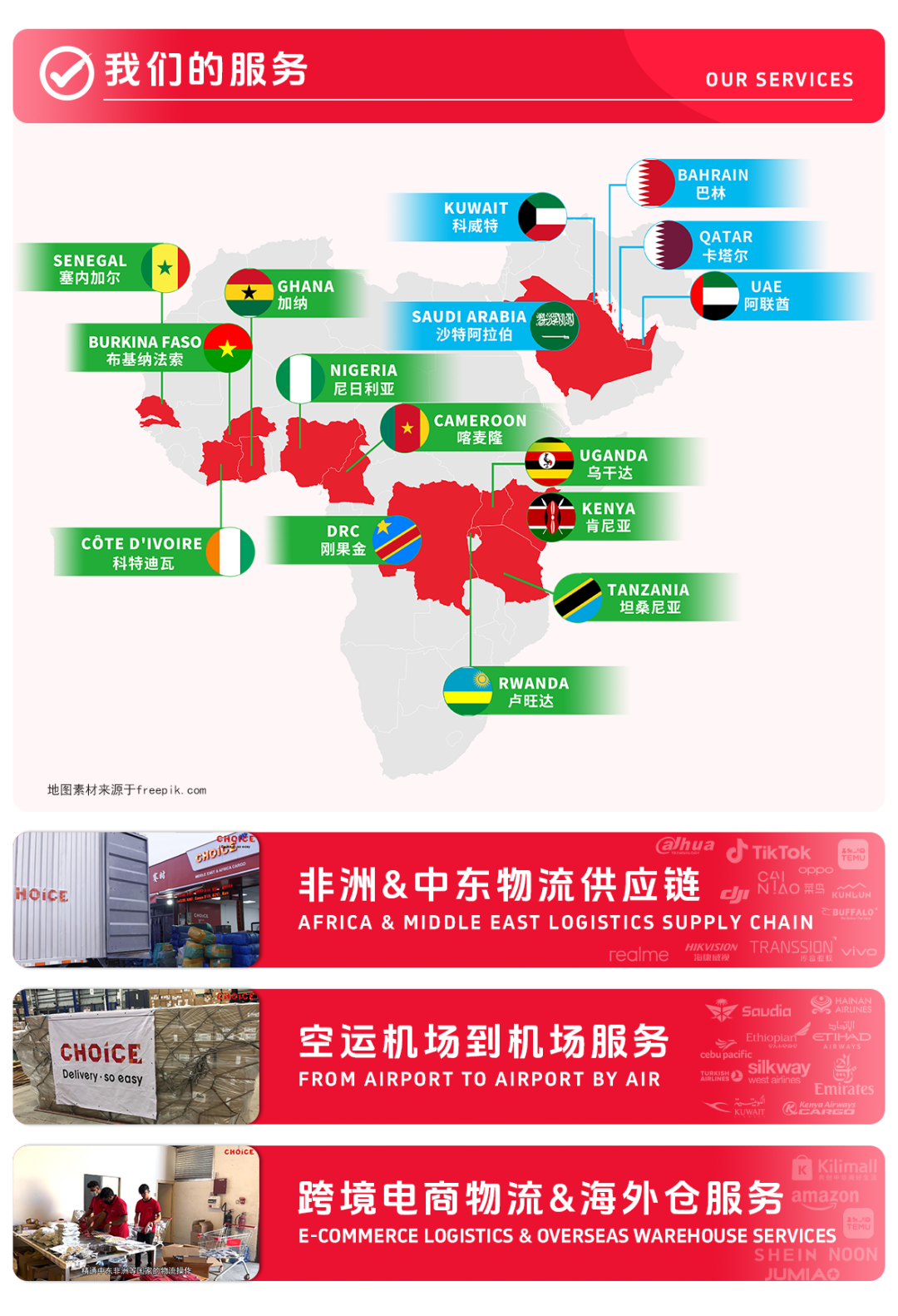
CHOICE International Freight, focusing on cross-border logistics in Africa & the Middle East. Founded in 1997, with 29 years of logistics experience, it provides one-stop cross-border logistics services such as air transportation, sea transportation, and overseas warehousing.
Tel: 400-613-8844